The Veil
A dress ... and a lens

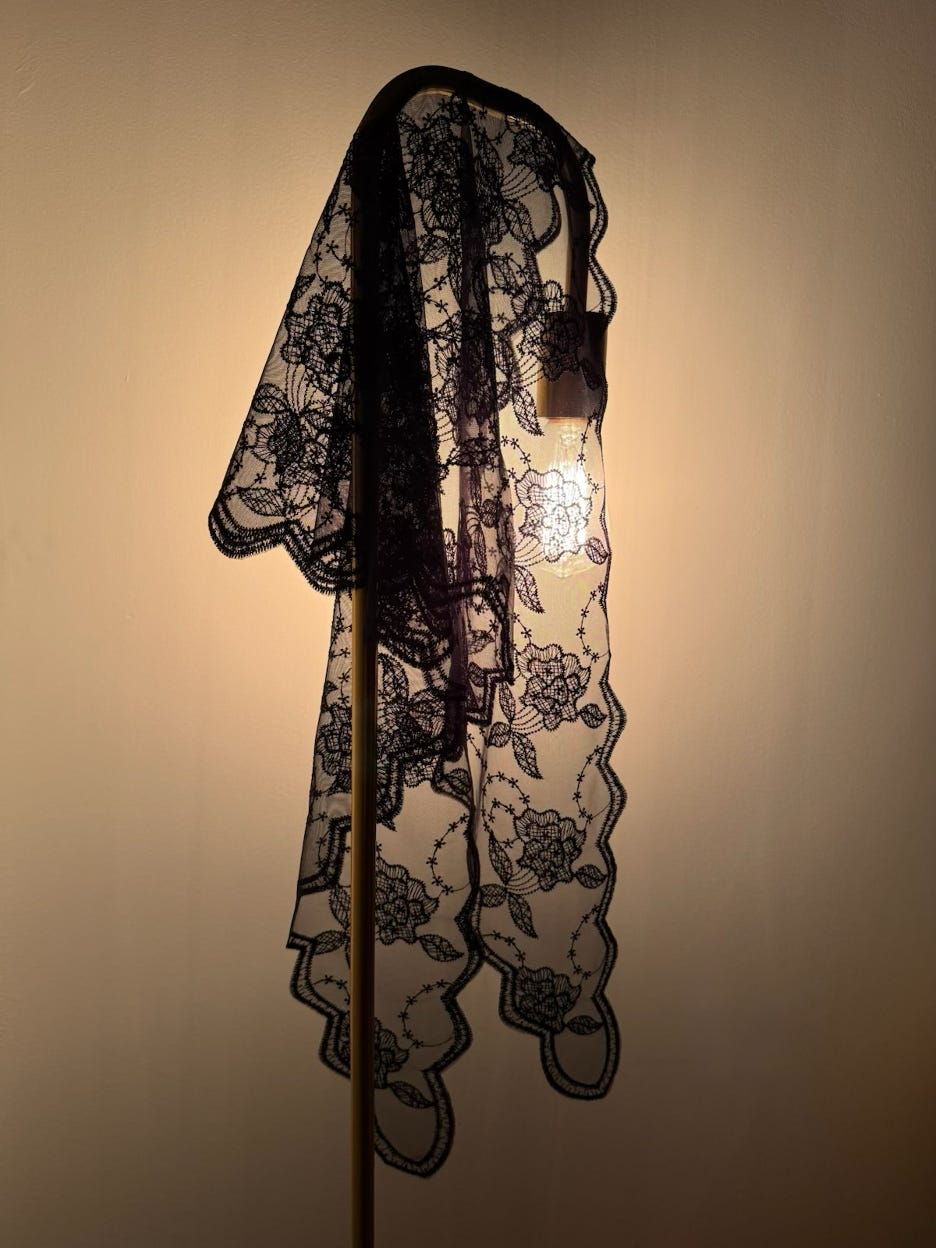
This Easter, two (un)related occurrences got me thinking about the veil: The work of the veil as a mode of dress, and the possibilities of the veil as a conceptual framework.
I should have been focused on the to the liturgical rigours of an online Easter Sunday Catholic mass. Instead, my eyes fell on a breathtaking light blue mantilla— that traditional female liturgical lace, or silk veil, or shawl, typically black in colour. “Wow”, I thought. The choir was doing its thing, but my ears totally failed to divert my mind’s eye which was transfixed on that hauntingly beautiful blue veil.
It would not leave me alone. It’s soft splendour. It’s unusual colour. Then I had a flashback to a conversation a few days earlier when my daughter had told me, “the mantilla has made a serious comeback; all the girlies are wearing it.”
Seriously? Now why would the mantilla, worn— to whatever extent one wishes— over the head, face, neck and shoulders, be appearing now in fast fashion stores that cater to the young and the restless? Not them being so sanctified! I entertained some thoughts about the contraries of youth, about religious traditions, modern commerce, conservative politics.
As mass ended, my mind settled on modern politics. Specifically, I recalled a moment, earlier in the day, when I had burst out laughing as I listened on X to a newsclip of President William Ruto declaring war on cartels.
“Hawa cartels wa mambo ya mafuta, watakipata. Hawawezi kuhepa, kwasabau haiwezekani.”
He was on a podium somewhere, swearing that the cartels involved in importing oil outside of his government-to-government arrangement will be cooked; there is no escape for them.
Really?
That presidential promise, delivered with the belligerence of an outburst rather than with the earnestness of a firm commitment, had come hot on the heels of the arrest of several top officials of the Ministry of Energy, the Kenya Pipeline Company and the Energy and Petroleum Regulatory Authority. They had been dragged from their homes on the afternoon of Good Friday, seemingly in time for the crucifixion.
Their resurrection is still awaited. But if you have been eligible to vote in at least two elections in this our land and nation you already know that they will rise again. And walk into the sunset smelling of roses. Why? Because our anti-corruption crusades are a veil.
The garbs we wear in our practice of politics mimic the sacred ones we don in our sites of worship.
More on these affinities and entanglements later. For now, the veil because I have already jumped on the revolving trends of fashion. But more than as mode of dress, I want to bring back the veil as a conceptual framework, a lens through which we can understand our institutions and our practices.
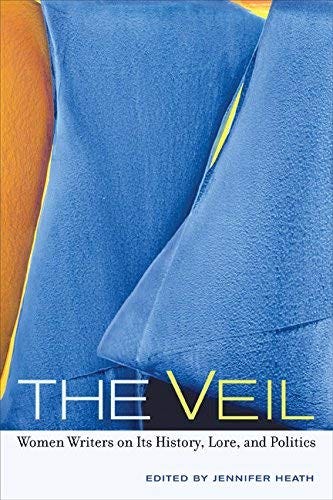
True, in recent years, feminist thought has paid a lot of attention to the veil. Its origins. Its politic(ization)s. Its cultural work outside of the stereotypes that box it. See for instance the 2008 edited volume by Jennifer Heath.
But I want to go back even further in time— to the American scholar and Pan Africanist, W.E.B. Du Bois, whose seminal work, The Souls of Black Folk, begins and ends with the metaphor of the veil. Thinking through the racist rigours of discrimination, injustice, and oppression Dubois adopts the veil as a metaphor for “the color line”. It is that (in)visible barrier that “separates, restricts, and masks” relations between whites and blacks. And it is here that Du Bois raises the double-consciousness created by the veil. That doubling dictates how black people see themselves, which stands apart from how they know themselves.
Let me work with Du Bois’s exposition of the metaphorical veil and use— not just any veil, but in particular— the mantilla. The mantilla’s lace or silk fabric works very well as a double-sided tool because it is translucent rather than opaque in the way that most many masks are. Whether it covers only the hair, or falls more fully over the face and the neck, the mantilla pushes you—the onlooker— back. At the same time, it draws you in, urging you to linger in your gaze, your inquiry. The mantilla conceals at the same time as it reveals.
Through the mesh of the fabric, its tiny apertures, you see outlines and fragments of what lies beneath. The hints ignite curiosity, open your imagination to run wild, to go beyond the traces of the veil’s seductive pattern and build full(er) contours. Through its hints and as a contour that grows in the mind, the veil is sexy, absolutely alluring in ways that the impenetrable mask can never be.
When you touch the mantilla, you feel a rising layer of dense(r) fabric which sits harmoniously beside a sheer translucence that lets in some air and some light, but not a whole lot. The very fine threads of the fabric threaten to allow your fingers to pierce through and land on that which you could only sense, or guess at, when caught sight of some fragments through the mantilla’s dimmed light. Touching it, you begin to appreciate fullness. You entertain, more extensively, a longing that the deceptive barrier of semi-transparency contains.
The veil promises and it disavows. As a garment that often accompanies the taking of vows in what is sometimes called as a white wedding, the veil creates some welcome drama. It brings an antiquated mystery to the ceremony, whose attendees wait on bated breath for the moment when the bride’s face will be revealed— as if she was hitherto unknown! The veil is participating in a carefully simulated lie.
It is a metaphor for the bride’s purity, for her innocence which it works hard to shield. In tandem with the vows, the veil works as a line that marks the moment before the bride and groom were married and the one after they are married. When that line is crossed, the veil is thrown back, to signal that permission has been granted for the groom to kiss the bride, for their desires to be displayed even if not fulfilled. The veil separates. And in its absence, it binds.
As a physical object, worn for religious purposes, the veil does the work of patriarchy by suggesting purity. It affords one a shy or demure pose that plays up piety. When it is enforced as a socio-cultural requirement, rather than a personal choice, those performative declarations of purity can be read as overt acts of oppression. The veil is then said to contain women, restricting their visibility, their ability, their volume. And who does this serve, the Almighty or the wannabe all-mighty?
But, when it is a garment of choice, there is power in the veil. Aside from the fact that it can help you hide warts and scars that you do not need the whole world staring at, there are other sense in which you can wield it as resistance discourse. You choose to wear it for a gathering where you only want to take a part of yourself, to keep away that which is most sacred to you. Your hair or your face, perhaps even your mind and your resourcefulness, will not be part of gatherings that you do not believe in. You avoid those dehumanizing, unrewarding spaces where you are un(der)valued, Where you are denied space to shape or to lead by veiling yourself. The optics of the veil serve your purpose. People assume you are too shy to be of value so they leave you alone. This gives you peace of mind.
Now what does all this have to do with President Ruto’s anti-corruption talk?
When Ruto veils, he pretends he is doing public good aka serving mwananchi. It is a performance of piety, of purity, of devotion to the public, of goodness within the confines of society.
But in truth, as financial analysts and political hounds quickly explained on social media last weekend when Ruto was declaring yet another war on corruption, this is a smoke and mirrors game. The real rot is being obscured by this veil of an anticorruption crusade. Some cynics even told us that the problem being attacked on that podium was not that some people had made corrupt oil importation deals, but that they shortchanged the dealer-in-chief
Veils connote silence, but the ones worn by our rulers bark their arrival. What was said on the podium and the whole spectacle of arrests we saw on TV conceal at the same time as they reveal. What is visible must never blind us to that which is invisible, that which is being sealed by arresting a few. Public declarations that serve personal commercial and political gains must be called out for what they are— ugly veils that can no longer hold alluring distraction or seductive power over the people because we have seen this script played out a little too often.
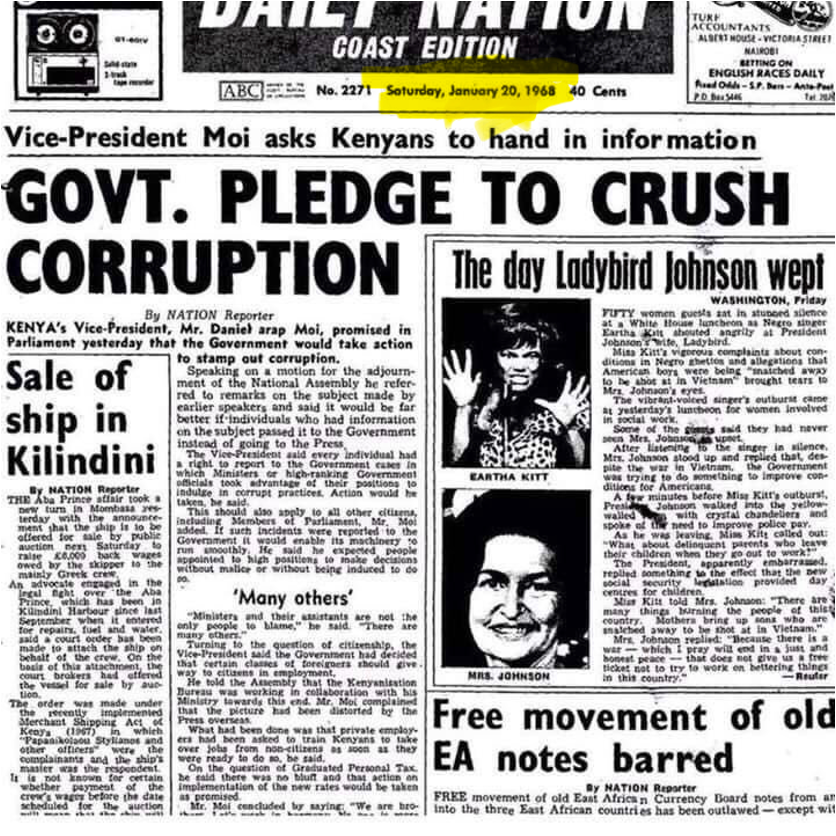
Indeed, indicating left and turning right has been a common practice of our rulers since the colony was demarcated and those practices persisted very soon after we said we were now ruling ourselves.
For instance, back in 1974 when the Deputy Secretary in the Ministry of Health, Zachariah M. Shimechero, was jailed for two and a half years for taking bribes to influence supplies at the Central Medical Stores. Corruption was not being fought. Not in earnest, and certainly not in total. A far more toxic practice was being veiled, buried away from public scrutiny.
The real rot of the Jomo Kenyatta regime was nepotism. Soon after independence, Shimechero should have been promoted to head the police force. Instead, his junior, Bernard Hinga, was appointed the first African Commissioner of Police. The insecurities of such undeserving people will hunt and haunt you until they completely erase you. It’s called giving a dog a bad name so that you can hang it. And so, Schimechero was jailed.
Given the dubious impetus and the unwillingness to pursue everyone else dealing graft in that era, Shimechero’s jailing did not put a stop to the criminal hustling of well-connected dealers at what is poetically called Mafya House. Which reminds me, did the powers that be really succeeded in placing an opaque mask on the thieves of Jack Ma’s COVID-19 donations? And someone will tell you we have a functional public health services, an independent anti-corruption agency, and independent investigative and policing bodies.
When we peer into the veils that President Ruto wears today, we find legacies of decay that precede him by decades. He wears the worn-out shrouds of a colonial state that long decided to consciously and repeatedly birth institutions that are designed to fail. Nothing signals this more clearly than the establishment of the Kenya Anti-Corruption Agency (later renamed Ethics and Anti Corruption Commission). The thoroughly lacy choice of the first appointee to head it was could only have been primed to conceal more than what it would reveal.
With information becoming more readily available in a host of platforms that government cannot control, the veil of anticorruption crusades has grown dangerously thin. We scan now see right through the mesh and very quickly identify the gap between what is being said and what is (not) being done; between who is being appointed and what they are meant to bury.
We arrive now at a crossroad in this marriage between veils and politics.
Our current rulers should reckon with the polarizing politics of veiling. In certain quarters, veiling is seen as a separatist culture that threatens the mainstream. With dire outcomes. But while the fury over the veiling of women in these quarters stems from willful ignorance and builds into unacceptable intolerance of “the other”, the veiling of our rulers to enable greed and graft is drawing justified anger over practices and institutional frameworks that can no longer hold no matter how close to the mainstream they are.
Things will fall apart and these performances of the pious and the vile which hurt our moral economy, our intellectual landscape, and on our nation’s fiscal health will soon be set ablaze.
**************************